Equity Wasn’t Just the Theme. It Was the Work.
One year after ICFP 2025, reflecting on the stories we told, the risks we took, and the community we built together.
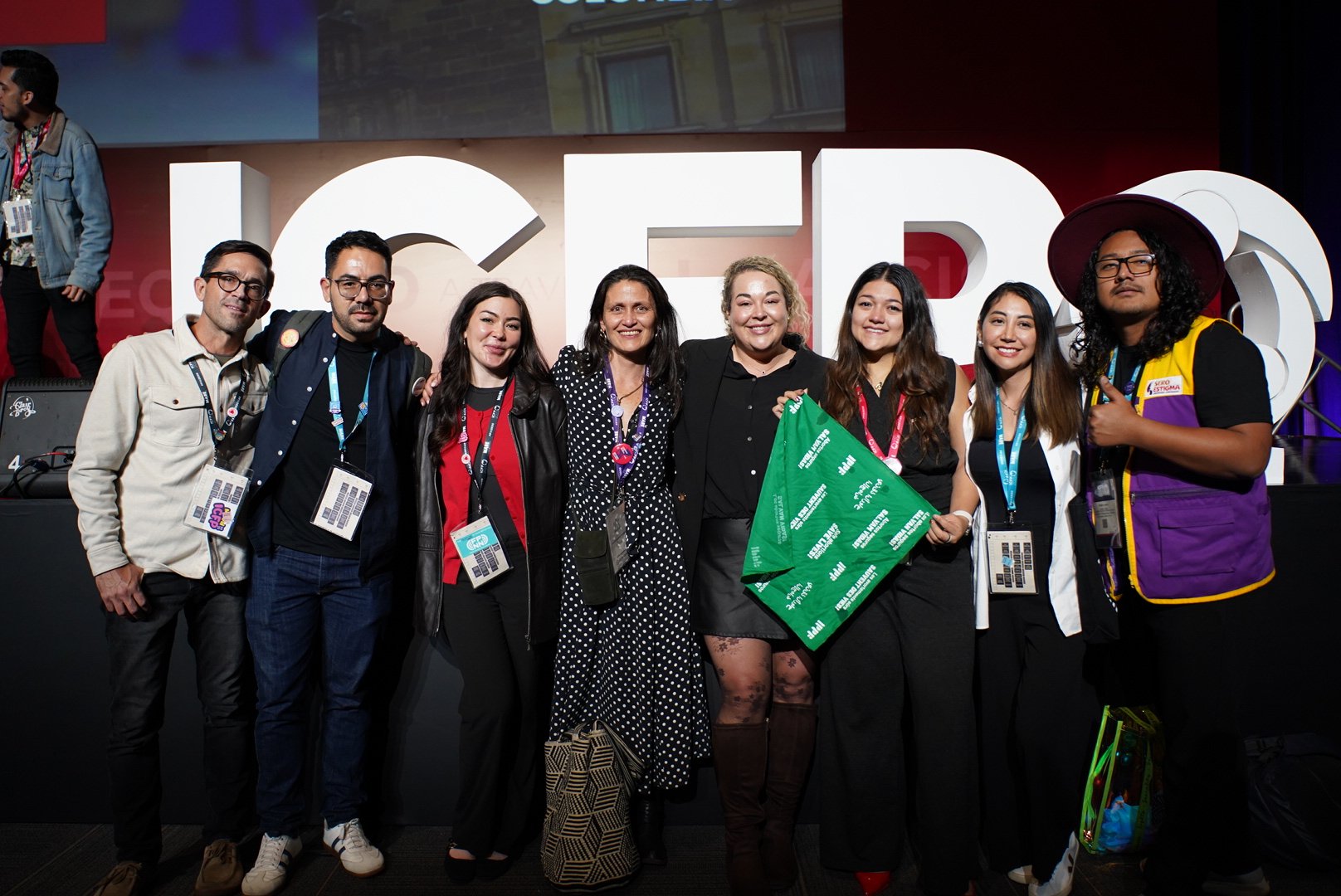
Family Planning News Network (FPNN) co-founders and community reporters celebrate at the ICFP 2025 Closing Ceremony in Bogotá, Colombia.
I remember sitting in the back row of a room filled with 3,500 people in Bogotá, Colombia, knowing that only a handful of us knew exactly what was about to appear on the screen.
Beside me were journalists who had traveled across Colombia with us just weeks earlier, along with colleagues who had spent months helping bring the 2025 International Conference on Family Planning (ICFP) to life. We were about to premiere Voices That Unite Us, a film honoring the communities, organizations, and Colombian partners who had made this historic gathering possible.
As the film played, we could feel the energy of the room. The journalists beside us cheered as the stories and communities they’d encountered appeared on screen. When it ended, the room erupted in applause. We looked at one another, hugged, and I think some of us cried.
It was one of the proudest professional moments of my life.
And then, almost immediately, the conference was underway.
There was little time to sit with what had just happened. Thousands of delegates had arrived in Bogotá, and the communications operation we’d spent years preparing was now in full motion.
A year later, with Voices That Unite Us nominated for an Anthem Award, I’ve been thinking about that moment, the people who made it possible, and what we set out to accomplish.
What Was at Stake
ICFP 2025 took place during an extraordinarily difficult year for global reproductive health and rights.
Across the sector, funding was disappearing, institutions were facing upheaval, and colleagues were losing their jobs. Every week brought new uncertainty about the future of work that so many people had dedicated their lives to advancing.
At the same time, we were preparing to bring ICFP to Latin America for the first time, with Spanish joining English and French as an official conference language. Despite the uncertainty facing our field, ICFP 2025 received a record 5,174 abstract submissions from 131 countries, a 66% increase over ICFP 2022. It was a powerful reminder that even as resources were shrinking, the desire to share knowledge, advance research, and come together as a global community remained stronger than ever.
We made difficult choices about what the conference truly needed, cutting extraneous “nice-to-haves” to prioritize bringing as many people together as possible.
As the communications lead for ICFP and institutional lead of the Family Planning News Network (FPNN) at Johns Hopkins Bloomberg School of Public Health, I knew this gathering needed to be more than a successful event.
We knew what was at stake. With so many people facing barriers to participation, our community needed meaningful opportunities to connect, learn, and be heard.
In moments of crisis, communications is often treated as something to scale back to the essentials: announcements, press releases, and the basic work of keeping people informed. But these are precisely the moments when communications has the potential to do something more consequential.
When resources are shrinking, and communities are being stretched apart, who gets access to information, whose expertise is amplified, and who gets to participate become strategic decisions, not simply communications decisions.
I wanted our work to reflect that responsibility.
Equity as a Responsibility
The theme of ICFP 2025 was Equity Through Action.
For me, that couldn’t just be something we printed on banners. It had to inform whose stories were told, who told them, and how they reached the world.
That belief is fundamental to the Family Planning News Network: trusting communities to tell their own stories.
International conferences and institutions have enormous power to shape how places and communities are represented. That power comes with responsibility. It’s easy to speak about centering local voices while still controlling the narrative from afar.
For us, putting equity into action meant being willing to share that control and trust journalists, local partners, and communities to bring forward stories we might never have identified or told ourselves.
Our Colombian counterparts had spent years making ICFP possible. They were gracious hosts, but also leaders, collaborators, and experts whose work deserved to be recognized on its own terms.
We wanted the global community to encounter stories beyond Bogotá, including from regions that rarely receive international attention, or too often only when something has gone wrong.
Rather than having the conference secretariat decide how Colombia should be represented, we wanted journalists to connect directly with communities, listen, and tell the stories that emerged.
Equity in storytelling isn’t simply about who appears on screen. It’s about who gets to shape the narrative.
Making Space for Stories
One of the initiatives I was most determined to make happen was a Colombia reporting delegation through FPNN.
We secured funding to bring journalists into the country ahead of ICFP to meet local organizations, connect with communities, and report on reproductive health and rights firsthand.
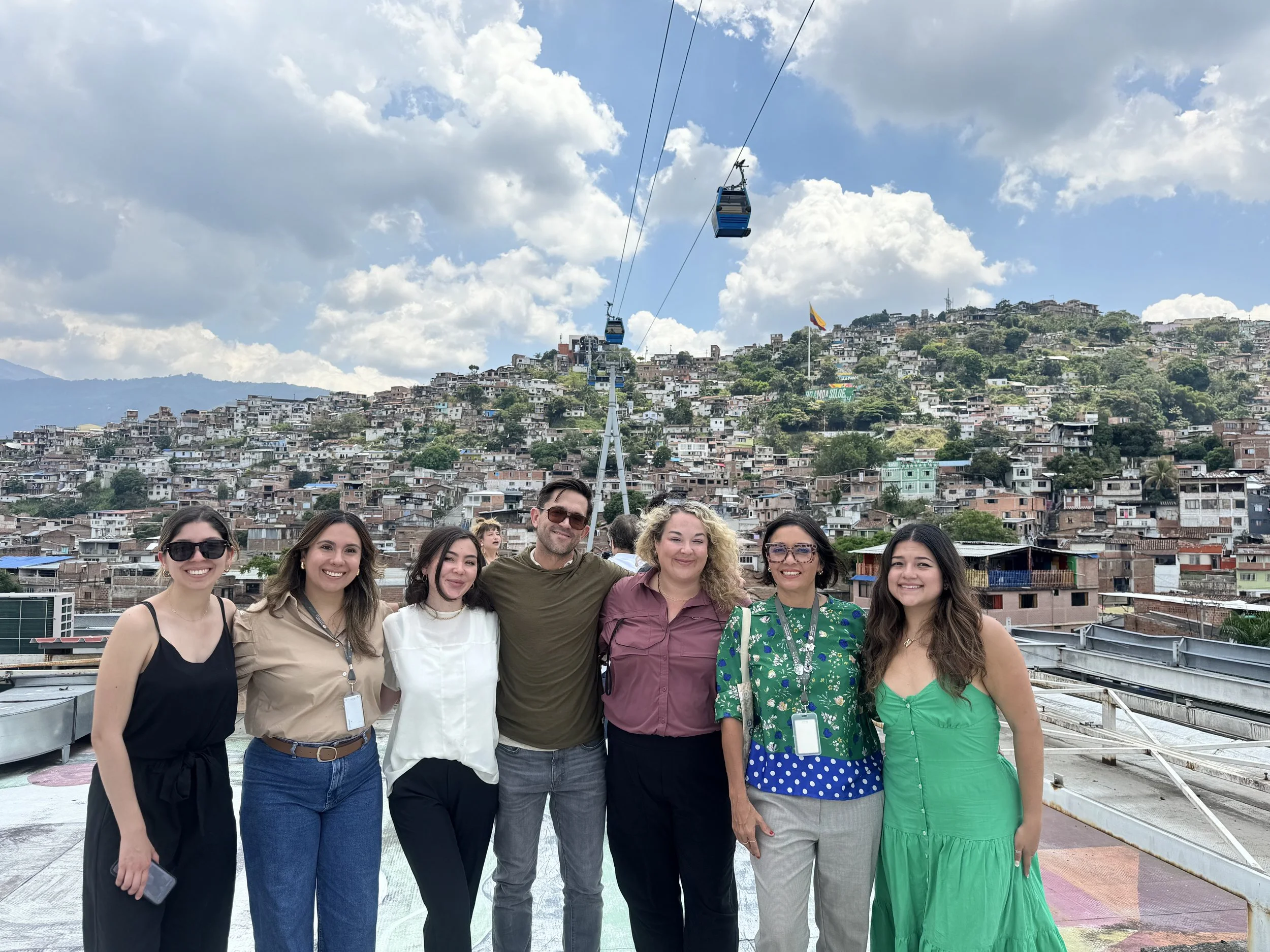
The delegation depended on the expertise, relationships, and generosity of our Colombian partners. Working closely with the Colombian National Steering Committee, local organizations, and colleagues on the ground, we developed a reporting experience rooted in the communities we hoped to highlight.
Then, because of violence in the country, we had to postpone the trip.
We rebuilt the plans and rescheduled it for two months later, leaving only a short window before the conference.
Meanwhile, we were managing global media engagement, digital campaigns, messaging, content production, and preparations for live programming amid visa complications, registration delays, geopolitical tensions, and countless other moving pieces.
But I believed in what the delegation could make possible.
The journalists returned with experiences, relationships, and stories that couldn’t have emerged from a conference office or communications brief. Their reporting and perspectives became part of the conversations they would lead and the stories they would share at ICFP.
And I began thinking about how we could bring those experiences to the opening ceremony.
A Love Letter to Our Colombian Partners
For Bogotá, I saw an opportunity to approach ICFP’s opening film differently. I proposed creating a film rooted in the reporting delegation’s experiences and the stories of our Colombian partners and the communities that welcomed us.
My colleague Molly Moesner and I wrote, produced, and edited Voices That Unite Us in less than two months, while continuing to manage our broader communications responsibilities.
But while two of us created the film, the story was the result of something much larger.
It came from the relationships our Colombian partners had built over years of work, the communities that welcomed journalists, and the reporters who approached those encounters with curiosity and care.
I told our Colombian counterparts that the film was a love letter to them—to Bogotá, to Colombia, and to everyone who had spent the previous two years making ICFP possible.
And I meant that.
We wanted to honor their leadership, generosity, and trust. We wanted to show the complexity and beauty of Colombia, the people advancing reproductive health in their communities, and the significance of bringing this gathering to their country.
It mattered enormously that our Colombian partners felt the film was respectful, that they recognized themselves and their work in it, and that they were proud of what we had created.
In a project centered on ethical storytelling, their response meant everything.
Building More Than an Audience
Voices That Unite Us was one expression of a much larger communications strategy.
Throughout preparations for ICFP 2025, I wanted to challenge the idea that communications existed primarily to publicize the conference once the substantive work had been done.
Communications could be part of the substantive work.
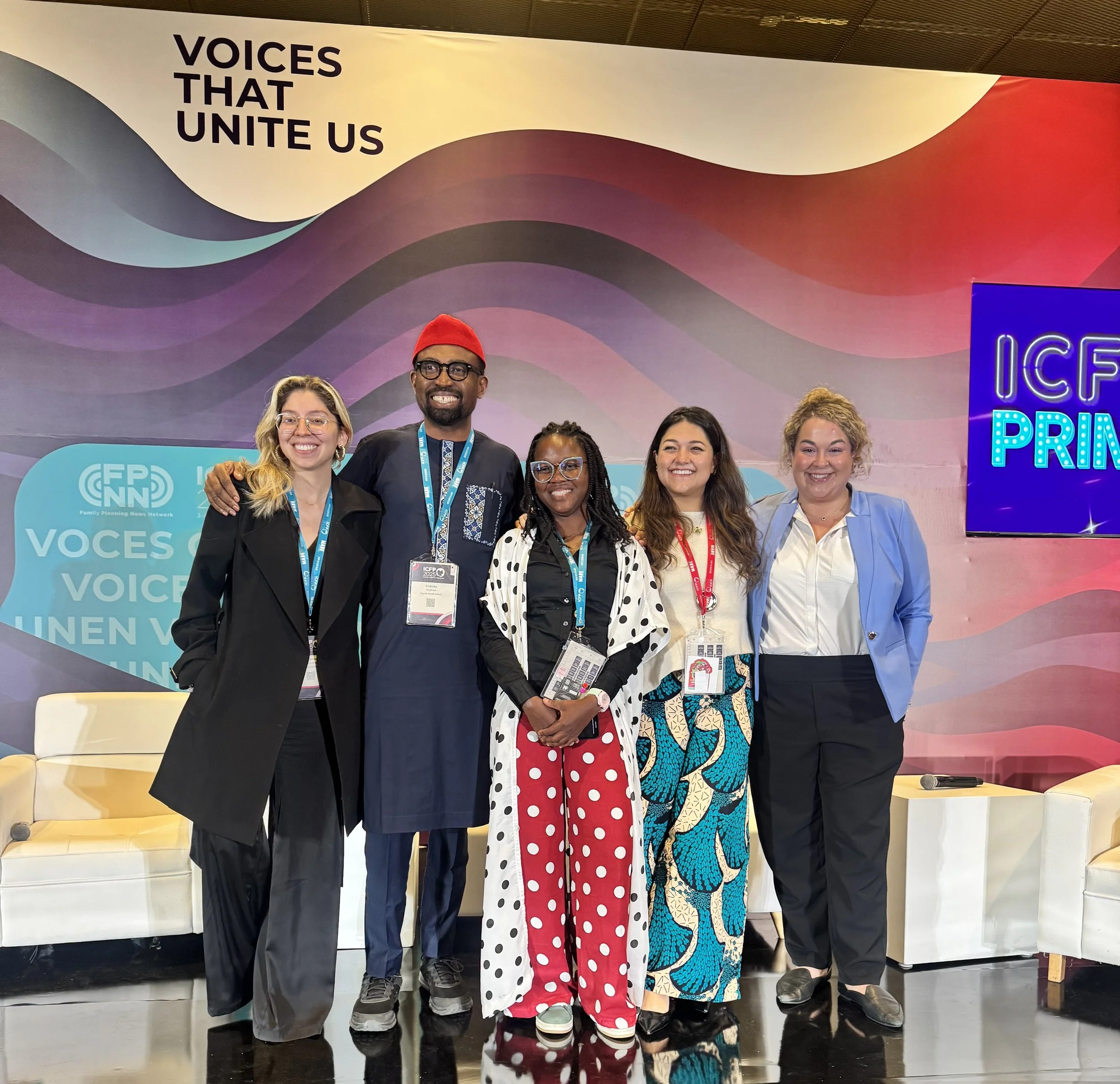
FPNN Community Reporters on the ICFP 2025 LIVE Stage.
Through FPNN, we developed a pre-conference Media Lab and the Colombia reporting delegation. We brought journalists into the conference experience through the ICFP LIVE Stage and daily programming, creating opportunities for audiences to engage with the conversations unfolding in Bogotá.
We produced original video content, interviews, and daily coverage for people who couldn’t attend in person. Our communications efforts generated more than 180 organic earned media mentions and engaged a community of more than 60,000 people.
We also helped preserve the conference’s conversations through the post-conference ICFP Impact Hub, extending their value beyond a single week.
Earlier in the year, we had supported the Future of Family Planning Convening, another major opportunity to bring people together during a period of uncertainty.
These weren’t isolated initiatives. They reflected a shared belief that communications could expand participation, elevate expertise, and sustain a community when that community was under enormous pressure.
The lesson I carry from ICFP 2025 is that communications shouldn’t be measured only by how many people see our work, but by what our work makes possible.
Did we create access for people who otherwise would have been excluded? Did we recognize expertise that might have gone unheard? Did we build something that would remain useful after the event ended?
Those questions are as important to me as impressions, media coverage, or audience growth.
And none of this happened because of one person. It required communications professionals, journalists, production collaborators, and institutional and local partners willing to build new things and solve problems together.
We tried to live Equity Through Action through the way we approached the work itself.
What We Carry Forward
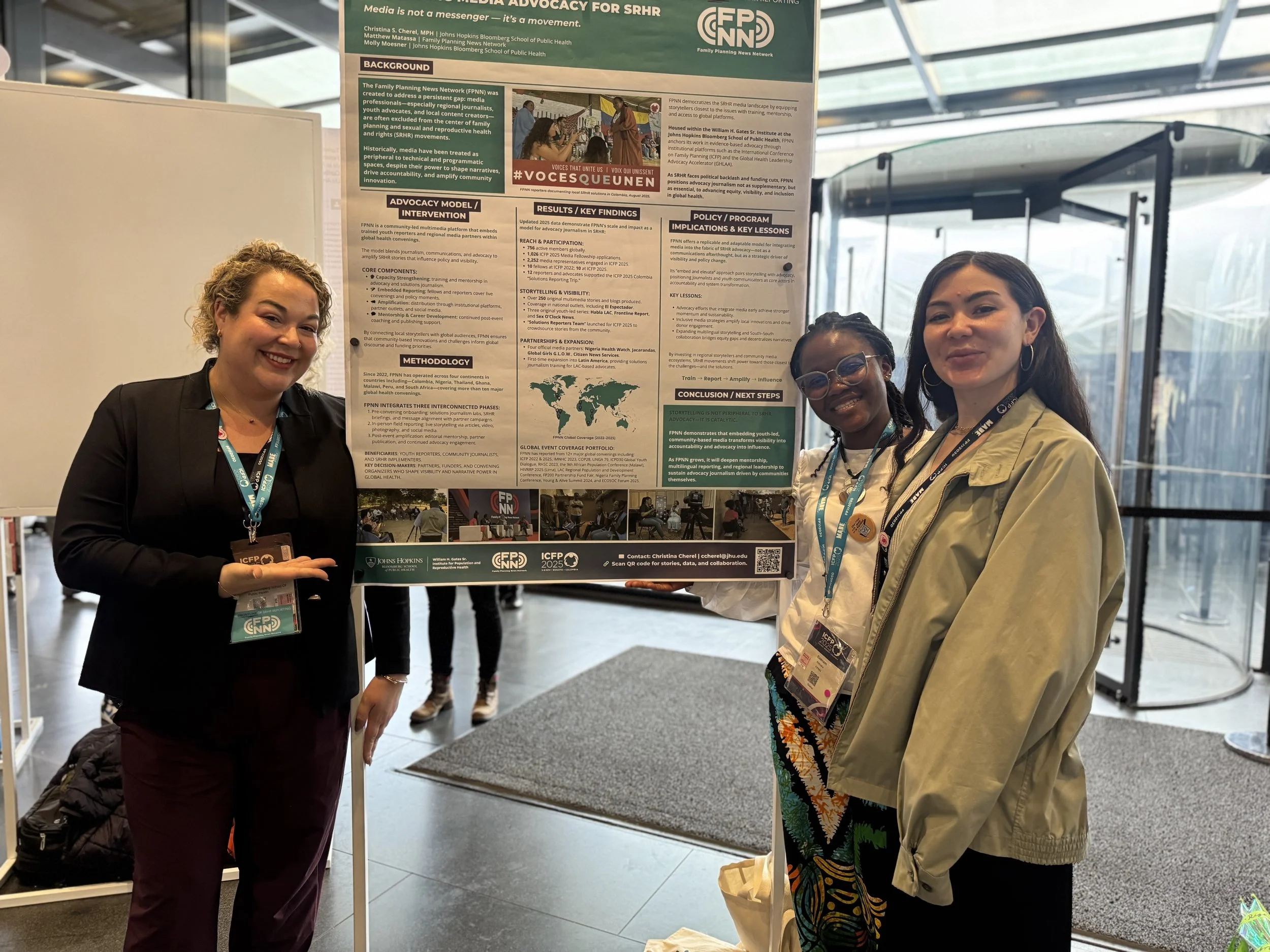
FPNN Co-founders Christina Cherel and Molly Moesner, alongside FPNN Community Reporter Esenam Amuzu, at ICFP 2025.
A year later, Voices That Unite Us has been nominated for an Anthem Award. I’m thrilled that the film is receiving recognition, especially because it gives more people an opportunity to encounter the stories and communities it was created to celebrate.
But the nomination isn’t what makes me proud of it.
I was proud of it in that room in Bogotá.
What stayed with me most wasn’t the applause, but knowing that the people we hoped to honor felt honored. Our Colombian partners were proud. The journalists could see their experiences reflected in something that reached thousands of people.
That experience reinforced something I’ve come to believe deeply over the course of my career: communications is not simply about making an organization’s work visible.
At its best, communications is part of how we advance the work itself.
It’s how we build trust, create access, share knowledge, connect people, and make room for stories that might otherwise go unheard.
I’ve spent more than 15 years working in sexual and reproductive health and rights, and what has kept me here is a shared belief in reproductive autonomy and the people who dedicate their lives to advancing it. Being part of this community has always meant being part of something bigger than myself, bigger than any one project or institution. The relationships we’ve built, the solidarity we’ve found, and our shared commitment to reproductive autonomy are what have made this community such a meaningful part of my life.
So much has changed since we gathered in Bogotá. Many of us have experienced professional upheaval, uncertainty, and the loss of spaces and routines that once brought us together.
But those changes don’t diminish what we built, or the community that made it possible.
A year later, I hope Voices That Unite Us reminds us what’s possible when we trust communities to tell their own stories, make equity a responsibility rather than simply a theme, and come together around something bigger than ourselves.
⸻
Watch the video: Watch on YouTube
Vote in the Anthem Awards: Cast your vote